UK American Football Betting: Match Odds and Spread Markets
 Available in US
By NFL Betting Analyst
Data-driven NFL betting intelligence for UK punters.
Updated:
I placed my first NFL spread bet from a cramped flat in Brixton twelve years ago, squinting at a laptop screen while the Kansas City Chiefs kicked off at one in the morning. The odds were displayed in fractional format I barely understood, the coverage was a grainy stream, and the only “guide” I could find was a bookmaker’s landing page telling me to sign up. The UK market for American football betting has changed beyond recognition since then — and yet the quality of information available to British punters has barely moved.
That gap is what this guide exists to fill. Around 14.3 million people in the UK now identify as NFL fans — nearly one in five adults. The NFL’s own international programme has turned London into the league’s second home, and the betting market has followed suit with record global wagering numbers season after season. But most of the content aimed at British bettors is still either a bookmaker’s promotional page dressed up as a guide, or a generic explainer copied from a US site with “soccer” find-and-replaced to “football”.
I have spent over a decade analysing NFL point spreads, bankroll structures, and UK-market wagering patterns. This guide distils that experience into something practical. You will find real data on the size and trajectory of the UK market, clear explanations of how NFL betting mechanics translate to British odds formats, an honest breakdown of strategy fundamentals, and a serious look at regulation and responsible gambling — the section most competitors skip or reduce to a single sentence.
Whether you are placing your first NFL wager or refining a system that already turns a modest profit, every section here is built around one principle: data beats opinion. The numbers do not lie, and the bookmakers certainly will not volunteer them. So let me walk you through what actually matters when you are betting on American football from this side of the Atlantic.
Table of Contents
- UK American Football Betting Markets and Odds Evaluation
- NFL Betting in Britain: Market Size and Growth
- How American Football Betting Works for UK Punters
- NFL Betting Markets Available to UK Punters
- When NFL Betting Markets Open and Close
- Strategy and Bankroll Basics at a Glance
- UKGC Regulation and Responsible Gambling
- Frequently Asked Questions About NFL Betting in the UK
- Where the Numbers Come From
UK American Football Betting Markets and Odds Evaluation
- The UK is home to 14.3 million NFL fans, and NFL betting interest is growing at over 20% per year — making it the fastest-expanding sports betting vertical in the British market.
- Three core bet types — moneyline, point spread (handicap), and totals — underpin every NFL market. Master these before exploring props, accumulators, or bet builders.
- Live betting now accounts for 53.4% of all wagering activity globally, creating real-time opportunities that did not exist three years ago.
- Bankroll management is non-negotiable: stake 2-5% per bet, track every wager, and set deposit limits before the season starts.
- Only bet with UKGC-licensed operators. The regulatory framework exists to protect you — use it.
NFL Betting in Britain: Market Size and Growth
Three years ago I ran a workshop at a sports analytics meetup in Manchester. I asked the room how many had bet on the NFL in the past season. About a third raised their hands. I asked how many could name the UK’s total sports betting Gross Gambling Yield. Silence. That disconnect — between a rapidly growing betting market and the near-total absence of hard data in punter-facing content — is where opportunity lives.
14.3 million
Estimated NFL fans in the UK — roughly one in five British adults
1.2 million
Monthly UK searches related to the NFL, representing 13% of Premier League search volume
£2.48 billion
Annual Gross Gambling Yield generated by UK sports betting as of early 2026
Those three figures tell a story that bookmaker landing pages never bother with. The UK sports betting market generates £2.48 billion in annual GGY, and football — the round-ball version — dominates with roughly £1.1 billion of that total and 5.8% of the adult population regularly placing football bets. American football sits nowhere near those numbers yet. But the growth rate is what matters. Interest in NFL betting across the UK has been climbing at over 20% per year, and the infrastructure is already in place: 78.47% of all UK sports betting revenue comes through online platforms, meaning a punter in Glasgow has access to the same NFL markets as someone in central London.
The UK provides approximately 3% of global NFL fan web traffic. That sounds small until you consider the US accounts for roughly 85%. Outside North America, the UK is the NFL’s most engaged market by search volume and broadcast viewership.
Compare this with the global picture and the trajectory becomes clearer. Legal wagers on the 2025 NFL season hit a record $30 billion, an 8.5% jump from the previous year’s $27.5 billion. The Super Bowl alone has become a standalone economic event — Super Bowl LX in 2026 was projected to attract $1.76 billion in legal bets, building on the $1.39 billion record set by Super Bowl LIX the year before. The appetite is there, the platforms are there, and the UK’s regulated framework makes it one of the safest markets in the world to operate in.
Why does any of this matter to you as a punter? Because market size drives liquidity, and liquidity drives odds quality. As more UK bettors enter NFL markets, bookmakers respond with tighter margins, deeper market coverage, and more competitive lines. Five years ago, finding an alternate spread line at a UK-licensed operator was unusual. Now most major operators offer alternate spreads, team and player props, and quarter-by-quarter markets as standard. Smart Betting Guide, an analytics platform tracking these trends, put it plainly: opportunities are expanding for broadcasters, sponsors, and event organisers alike as the UK cements its position as a second home for the sport. That expansion filters directly down to the betting markets you and I use every week.
The bottom line is straightforward. NFL betting in the UK is no longer a niche curiosity. It is a rapidly maturing vertical inside the world’s most tightly regulated gambling market, and the punters who treat it with the same analytical rigour they apply to Premier League accumulators will find edges that casual bettors miss entirely.
How American Football Betting Works for UK Punters
The first time a mate asked me to explain the difference between a moneyline and a spread, I watched his eyes glaze over within thirty seconds. I was using American terminology, American odds formats, and American assumptions about what a bettor already knows. The lesson stuck: if you are coming from UK football betting, the concepts behind NFL wagering are not complicated — but the language barrier is real, and nobody bridges it properly.
Let me strip it back to fundamentals. There are three core bet types in American football, and every other market you will encounter is a variation or combination of these three.
Moneyline — a straight bet on which team wins the game. No margin required. If your team wins by one point or forty, you collect. This is the closest equivalent to a “match result” bet in UK football, with one critical difference: NFL games cannot end in a draw during the regular season (overtime rules ensure a result), so you are always choosing between two outcomes.
Point spread — known as “handicap” at most UK bookmakers. The bookmaker assigns a points advantage to the underdog (or a deficit to the favourite) to level the field. If the spread is -6.5 on the favourite, they must win by 7 or more for a spread bet to pay out. This is the most popular NFL bet type globally and the one where the sharpest edges tend to appear. I break this down fully in my detailed guide to NFL point spread betting.
Totals — also called over/under. The bookmaker sets a combined score for both teams, and you bet on whether the actual total will finish higher or lower than that number. A typical NFL total sits between 40 and 55 points, depending on the matchup. Weather, pace of play, and defensive quality all influence where the line is set.

Every other NFL market — player props, futures, accumulators, bet builders — is constructed from these building blocks. Understanding them properly means understanding everything that comes after.
Now, here is where the UK-specific wrinkle comes in. When you open an NFL market at a UK-licensed bookmaker, odds are displayed in fractional format by default. A spread bet that an American site lists at -110 appears as 10/11 on your screen. Decimal format — 1.91 for that same line — is available as a toggle on most platforms but rarely the default. If you have been betting on Premier League matches your entire life, fractional odds are second nature. But the maths behind NFL odds works the same regardless of format: the bookmaker builds in a margin (the overround or “vig”), and your job is to identify where that margin is thinnest relative to the true probability of an outcome. I cover the conversion formulas and value-finding methods in my guide to NFL betting odds in the UK.
The practical process of placing an NFL bet in the UK follows the same flow as any other sport. You register with a UKGC-licensed operator, complete the identity verification (KYC) required by regulation, deposit funds via debit card, PayPal, Apple Pay, or bank transfer, and navigate to the American football or NFL section. Select your game, choose your market, enter your stake, and confirm. Settlement happens automatically once the game concludes — no manual claiming required. The overwhelming majority of UK sports betting happens online, so the process is entirely digital for most punters.
One terminology trap I see constantly: UK sites label the spread as “handicap”, which is correct within the British betting tradition but can confuse you when reading American analysis. If a US preview says “the Chiefs are -3.5 against the spread”, that is identical to a UK bookmaker listing Kansas City at -3.5 on the handicap market. Same bet, different vocabulary. The spread and handicap terminology runs in parallel across every guide on this site, so you will always know which is which.
A final point worth emphasising early. NFL games are settled in a single sitting — there is no two-leg aggregate, no draw to complicate matters (playoff overtime is sudden death, regular season overtime has its own rules but still produces a winner). That structural simplicity is one of the reasons NFL betting translates so cleanly to UK platforms. You pick a market, set a stake, and wait roughly three hours for a result. The complexity is not in the process — it is in the analysis that precedes the bet.
NFL Betting Markets Available to UK Punters
When I started covering NFL markets for UK audiences, the typical bookmaker offered three options: moneyline, spread, and totals. Full stop. Walk into that same market today and you will find prop bets on individual quarterback passing yards, bet builders combining six selections within a single game, and live odds updating with every snap. The depth is staggering — and navigating it without a framework is a fast way to drain your bankroll.
NFL betting markets break cleanly into phases tied to the season calendar. Understanding what is available and when gives you a structural advantage over punters who only engage during Super Bowl week.
Pre-season and futures. Before a single regular-season snap, bookmakers open outright markets: Super Bowl winner, conference winners (AFC/NFC), division winners, season win totals, and individual awards such as MVP and Offensive Rookie of the Year. These are long-range positions. Your money is locked up for months, but the odds are at their most generous when uncertainty is highest. The NFL Draft in April creates its own mini-market — first overall pick, position props, and over/under draft slot bets attract sharp action well before training camp opens.
Regular season game markets. Once the 18-week schedule kicks off, the full range opens up for every fixture. Moneyline, spread, and totals are the foundation. Layered on top are player props — passing yards, rushing yards, anytime touchdown scorer, receptions — and team props such as total first downs or total sacks. Accumulators (parlays in US parlance) let you combine selections across multiple games, while bet builders allow you to stack picks within a single match. Both amplify returns but multiply risk in equal measure.
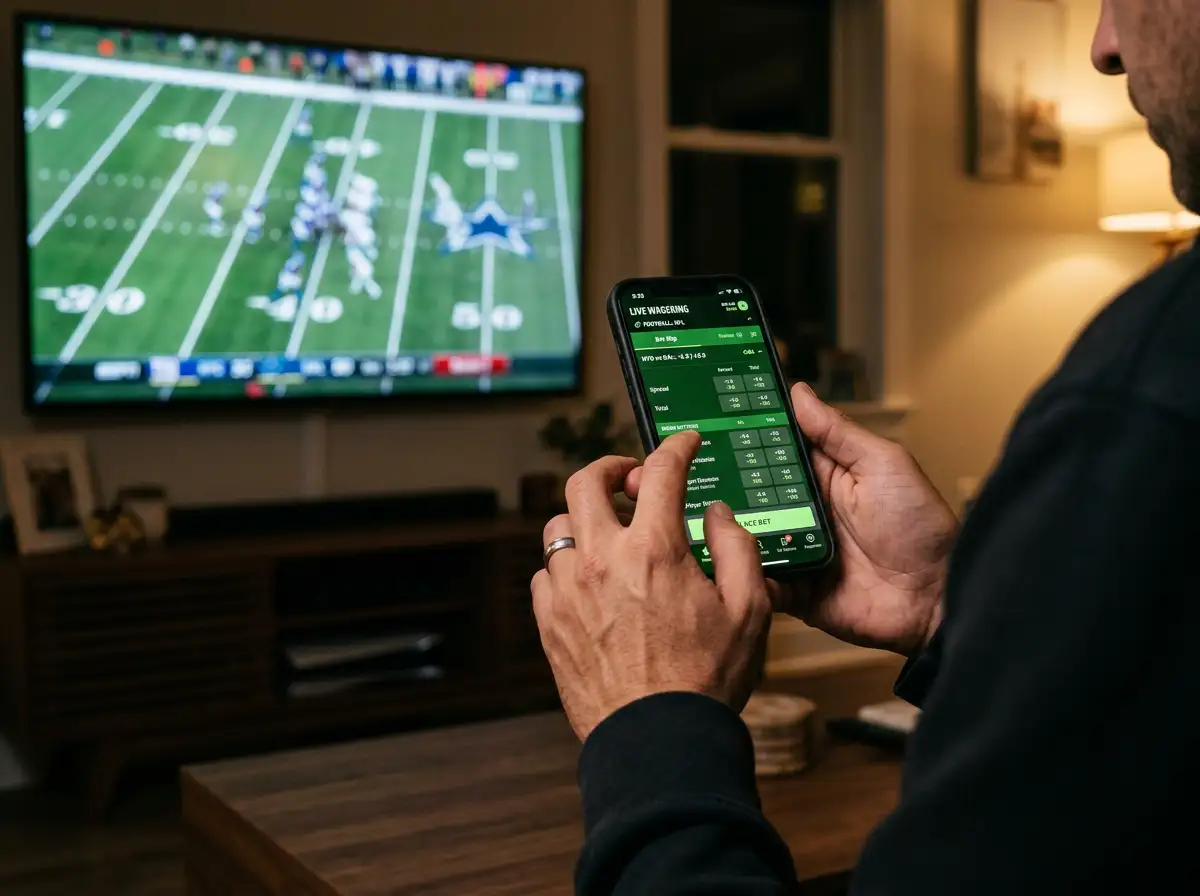
Live and in-play markets. This is where the market has shifted most dramatically. Live betting now accounts for 53.4% of all wagering activity globally — the first time in-play has overtaken pre-match. NFL live markets include live spread, live totals, next scoring play, drive result, and quarter-by-quarter outcomes. The pace of an NFL game, with its natural stoppages, actually creates cleaner windows for in-play decision-making than continuous-play sports. I explore the tactical side of this in my guide to NFL live betting and in-play markets.
Playoff and Super Bowl specials. As the field narrows from 32 teams to the final two, market depth shifts rather than shrinks. Prop bets on the Super Bowl alone can number in the hundreds — everything from the result of the coin toss to the length of the national anthem. The Super Bowl betting guide covers those markets in full, but the key point here is that the biggest single-day betting event on earth is fully accessible to UK punters through any UKGC-licensed operator.
Futures and Outrights
Super Bowl winner, conference and division champions, MVP, season win totals. Available year-round with odds adjusting weekly.
Game Markets
Moneyline, point spread (handicap), totals, player and team props, bet builders, accumulators. Open from Tuesday/Wednesday for the upcoming gameweek.
Live and In-Play
Live spread, live totals, quarter bets, next scoring play, drive results. Available from kick-off through the final whistle on mobile and desktop.
| Season Phase | Key Markets | Typical Availability Window |
|---|---|---|
| Off-season (Feb-Aug) | Super Bowl futures, draft props, season win totals | Year-round; odds sharpest post-draft |
| Regular season (Sep-Jan) | Full game markets, player props, accumulators, live betting | Lines open mid-week, live from kick-off |
| Playoffs (Jan-Feb) | Game markets plus enhanced props, conference winner updates | Lines open after Wild Card weekend |
| Super Bowl (Feb) | Hundreds of prop markets, specials, entertainment bets | Two-week window from Conference Championship |
London Games: A Unique Betting Market
I queued outside Tottenham Hotspur Stadium at half seven on a grey October morning for one of the 2024 London games, surrounded by fans wearing jerseys from teams that do not even play each other that day. The atmosphere felt nothing like an NFL stadium in the States — and neither do the betting dynamics.
Tottenham Hotspur Stadium is the only venue outside the United States purpose-built for American football, with a retractable football pitch that reveals a synthetic NFL-standard playing surface beneath.
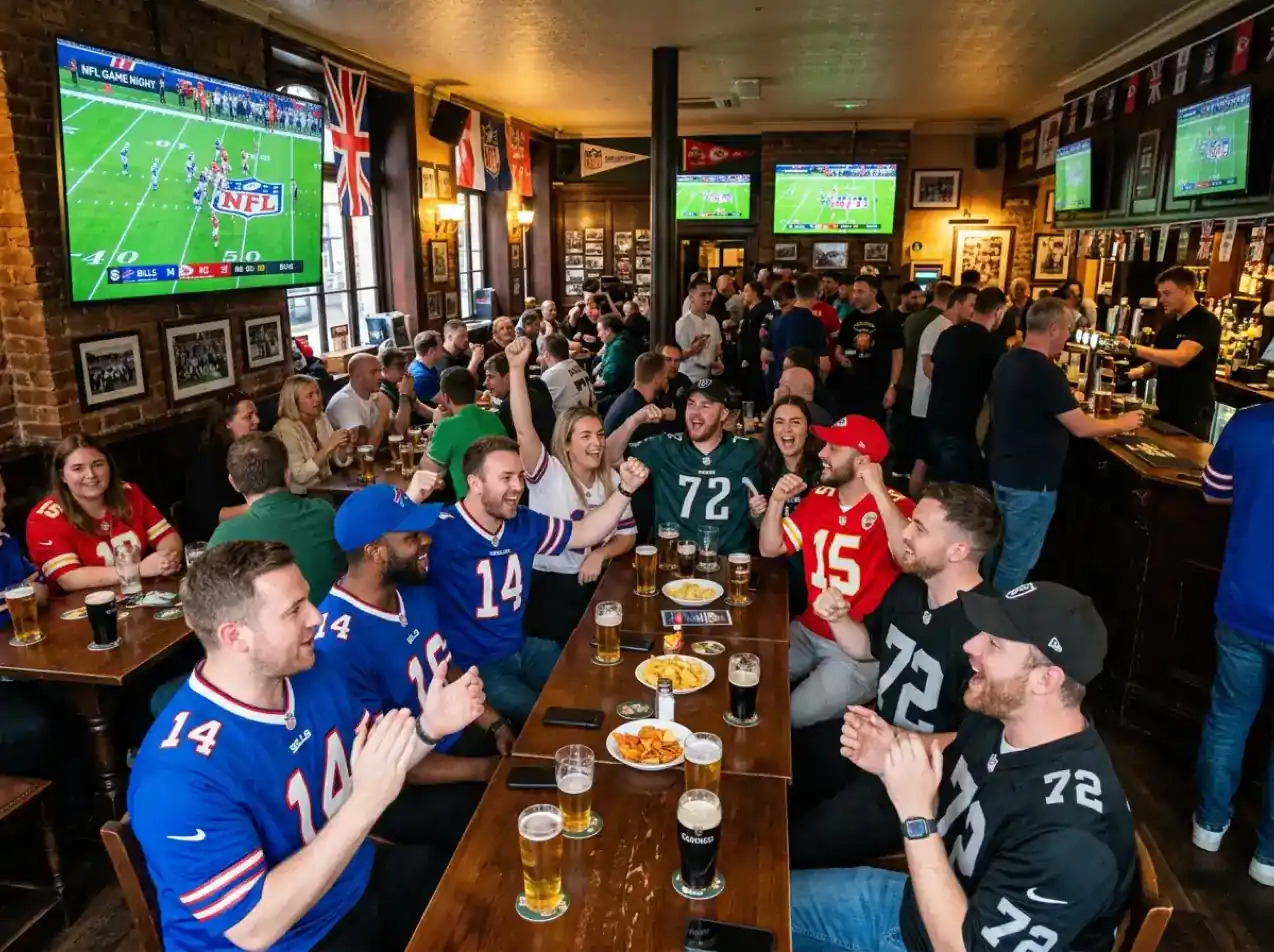
Since 2007, London has hosted more than 36 regular-season NFL games with a combined attendance exceeding three million. The 2025 series set a viewership record for the international programme, with over six million people watching across television and digital platforms. London’s sporting events contributed an estimated £230 million to the local economy in 2024 — and the NFL’s share of that figure continues to grow. As London Loves Business noted in their end-of-season analysis, the 2025 season represented a major leap forward: London’s games were not just exhibition fixtures, they were meaningful contests with global attention, and the betting markets matured alongside them.
What makes London games distinct from a betting perspective is the travel factor. Teams flying from the US West Coast face a more severe adjustment than East Coast clubs. Jet lag, disrupted preparation schedules, and the novelty of a neutral venue all create angles that do not exist in a standard Sunday slate. Historical against-the-spread (ATS) records for London games show patterns worth studying — particularly around teams making their first transatlantic trip versus those returning for a second or third time. Travel distance, arrival timing, and the neutral-venue dynamic all play into how these games land relative to the spread.
London games also generate UK-specific betting interest. Bookmaker search data shows spikes in NFL betting activity during weeks when London hosts a game, with new account registrations for NFL markets peaking in October — the month most London fixtures are scheduled.
With the full range of markets mapped out, the next question is timing — when do these lines open, and how does the NFL calendar align with the UK betting week?
When NFL Betting Markets Open and Close
I learned this lesson the expensive way during my second season of serious NFL betting. I woke up on a Sunday morning, liked a spread, went to place it — and found the line had moved a full point overnight. The value I had spotted on Friday evening had evaporated by Saturday lunchtime because I did not understand when UK bookmakers adjust their NFL lines, or how the US news cycle drives those adjustments on a timetable that does not align with British habits.
The NFL betting week operates on a predictable rhythm, but it runs to Eastern Time — five hours behind GMT, six behind BST during the summer schedule overlap. Lines for the upcoming gameweek typically open on Sunday evening US time, which means Monday morning for UK punters. Those opening lines are the rawest, least efficient numbers the market produces, and they attract the sharpest bettors first. By Tuesday and Wednesday, the lines begin to settle as volume increases. Thursday brings the first injury designations, and Friday afternoon (US time — late Friday evening in the UK) delivers the final injury reports that drive the last wave of significant line movement before Sunday kick-off.
| Day (UK Time) | What Happens | Betting Implication |
|---|---|---|
| Monday morning | Opening lines released for next gameweek | Best window for early value; lines least efficient |
| Tuesday-Wednesday | Lines settle as volume builds | Market consensus forming; odds narrow |
| Thursday | Initial injury designations released | First meaningful line shifts on injury news |
| Friday evening | Final US injury reports published | Last major line movement pre-game |
| Saturday | Late scratches and weather updates | Totals affected by wind/rain forecasts |
| Sunday 18:00 GMT | Early window kick-offs (1:00 PM ET) | Live markets open; largest batch of games |
| Sunday 21:05-21:25 GMT | Late afternoon window (4:05/4:25 PM ET) | Typically stronger matchups; sharper lines |
| Monday 01:20 GMT | Sunday Night Football (8:20 PM ET) | Primetime game; heaviest single-game volume |
| Tuesday 01:15 GMT | Monday Night Football (8:15 PM ET) | Final game of gameweek; closes the slate |
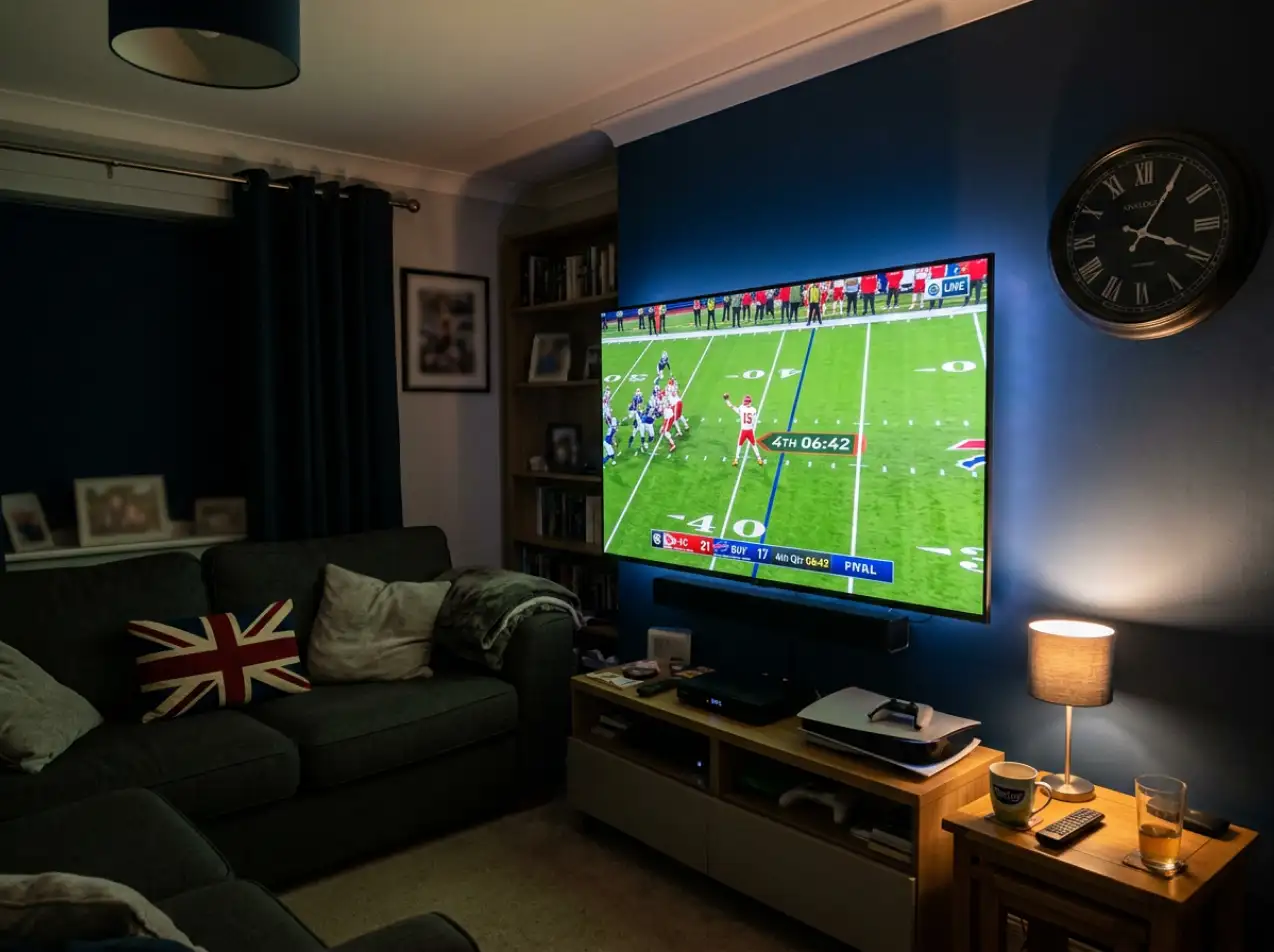
The UK broadcast schedule adds a practical layer. Sky Sports carries the main NFL coverage, Channel 5 runs highlights packages, and NFL Game Pass provides full access to every game on demand. For live betting, you need to be watching in real time, which means the early Sunday window at 18:00 GMT is the most accessible slot for British punters — it falls comfortably within a normal evening. The late window pushes past 21:00, and primetime games do not kick off until well after midnight. If you are serious about live betting on Sunday Night or Monday Night Football, plan your sleep accordingly.
Understanding this calendar does more than help you watch games. It tells you when to act. Monday morning is the time to scan opening lines for obvious value. Friday evening is the time to finalise positions based on injury news. Sunday afternoon is preparation time for the live markets that open at 18:00. Each window has a different purpose, and treating them all the same is how you end up chasing lines that moved hours ago.
Strategy and Bankroll Basics at a Glance
Here is a number that should make you pause: UK punters place approximately 290 million online bets on real events every single month. The vast majority of those bets are placed without any bankroll structure whatsoever — no unit system, no staking plan, no pre-defined loss limit. That is not betting. That is gambling blindfolded.
Do
- Set a dedicated NFL bankroll — money you can afford to lose entirely without affecting your life
- Stake 2-5% of that bankroll per bet (a “unit”), keeping exposure consistent
- Track every wager in a simple spreadsheet: date, market, odds, stake, result
- Compare your closing line value (CLV) over time — it is the single best predictor of long-term profitability
Don’t
- Chase losses by doubling stakes after a bad week
- Stake more than 5% of your bankroll on any single NFL bet, regardless of confidence level
- Treat accumulator windfalls as proof of edge — they are variance, not skill
- Bet on your favourite team without running the same analysis you would apply to any other fixture

The unit system is the foundation of every serious NFL bettor’s approach. One unit equals a fixed percentage of your bankroll. If you start with £500 and define a unit as 2% (£10), every bet you place is either one unit, two units (for high-confidence plays), or you skip entirely. No exceptions. This structure does two things: it prevents catastrophic losses during cold streaks, and it forces you to evaluate each bet on its merits rather than chasing the emotional high of a big payout.
Before You Place Any NFL Bet
- Have I checked the spread/total at a minimum of three UK bookmakers?
- Have I reviewed the latest injury report for both teams?
- Is my stake within my unit range (2-5% of current bankroll)?
- Am I betting based on analysis, or reacting to a result I just watched?
- Have I logged this bet in my tracking spreadsheet?
Unit system in practice
Starting bankroll: £500. Unit size: 2% = £10.
Week 1: three bets at 1 unit each (£30 total exposure). Results: 2 wins at 10/11, 1 loss. Net: +£8.18. New bankroll: £508.18.
Week 2: recalculate unit — 2% of £508.18 = £10.16. Stake £10 per bet (round down for simplicity). The bankroll grows and so does the unit, but slowly, keeping risk proportional.
Bill Miller, president and CEO of the American Gaming Association, framed it well when he said that legal sports betting enhances the fun and competition that make NFL traditions special. But fun without structure is how casual betting turns into problem gambling. Strategy and discipline are not optional extras — they are the price of admission to sustainable NFL betting. I go deeper into line shopping, advanced metrics like EPA and DVOA, and seasonal patterns in the full NFL betting strategy guide.
UKGC Regulation and Responsible Gambling
I once sat on a panel at a betting industry conference where a speaker described responsible gambling messaging as “the bit nobody reads”. The audience laughed. I did not. Because the data behind those messages is the most important set of numbers in this entire guide — and ignoring it is the most common mistake in the industry.
Approximately 340,000 adults in the UK meet the clinical criteria for problem gambling, and a further 1.8 million are classified as “at risk”. The overall problem gambling rate stands at 2.7% of the adult population by the Problem Gambling Severity Index (PGSI), a figure the UK Gambling Commission describes as “statistically stable” since 2023.

The UK operates under one of the most comprehensive gambling regulatory frameworks in the world. The Gambling Commission (UKGC), established under the Gambling Act 2005, licenses every operator permitted to offer betting services to UK residents. Any bookmaker offering NFL markets to you must hold a UKGC remote gambling licence. This is not optional. Operators without this licence are breaking the law, and betting with them strips you of every consumer protection the framework provides.
What does that protection actually look like in practice? Every UKGC-licensed operator must offer a suite of self-management tools: deposit limits (daily, weekly, monthly), loss limits, wager limits, session time reminders (reality checks), and cooling-off periods. These are not buried in settings menus — regulation requires operators to make them accessible and visible. Beyond individual tools, the UK introduced GamStop in 2018, a free national self-exclusion scheme. Registering with GamStop blocks you from all UKGC-licensed online gambling sites for a period of your choosing: six months, one year, or five years.
Andrew Rhodes, the UKGC’s Chief Executive, highlighted why this data matters in practical terms when he urged operators to examine the risks within their own customer bases, noting that new survey findings deepen our understanding of the consequences of gambling and provide crucial insight into frequent-gambler risk profiles. That is not corporate boilerplate — it is a direct instruction from the regulator to the industry.
The financial scale of the regulatory response underlines how seriously the UK takes this. In 2025, the government introduced a statutory levy of £100 million specifically to fund gambling harm reduction programmes — research, prevention, and treatment. Participation in online sports betting currently sits at 8% of the UK adult population, and a gender gap persists: 15% of men bet on sports compared to 4% of women. Among younger demographics, 30% of 11-to-17-year-olds spent their own money on some form of gambling over a twelve-month period in 2025, up from 27% the previous year. Tim Miller, Executive Director of the UKGC, noted that even with that increased participation, the percentage of young people scoring four or more on the youth-adapted problem gambling screen had not increased but had actually moved from 1.5% to 1.2% — statistically stable, but a figure worth monitoring closely.
Responsible gambling is not a footnote to strategy — it is part of strategy. A punter who sets deposit limits, uses reality checks, and defines a clear bankroll before the season starts is not being cautious. They are protecting the structural foundation that makes disciplined NFL betting possible over years, not just weeks.
If you are reading this guide as someone who bets occasionally for entertainment, the tools above are guardrails you should set once and forget. If you are reading it as someone who recognises patterns of chasing losses, increasing stakes after bad beats, or feeling anxious about betting outcomes — those are signals. BeGambleAware and GamCare offer confidential support, and the National Gambling Helpline is available around the clock. No guide on this site will ever tell you that the next bet will fix the last one. That is not how any of this works.
Frequently Asked Questions About NFL Betting in the UK
How does NFL betting work in the UK?
NFL betting in the UK works through UKGC-licensed online bookmakers that offer American football markets alongside traditional sports. You register an account, complete identity verification, deposit funds, and select from available NFL markets including moneyline (match result), point spread (handicap), totals (over/under), player props, and futures. Odds are typically displayed in fractional format by default, though most UK platforms allow you to switch to decimal. Games are settled once the final whistle blows, and winnings are credited to your account automatically. The process is identical to betting on any other sport through a UK-licensed operator — the only difference is the terminology and the time zones.
Is it legal to bet on American football in the UK?
Yes. Betting on American football, including all NFL regular-season games, playoffs, and the Super Bowl, is fully legal in the UK for adults aged 18 and over. The UK Gambling Commission regulates all remote gambling operators under the Gambling Act 2005, and any bookmaker offering NFL markets to UK residents must hold a valid UKGC licence. This makes the UK one of the most tightly regulated markets in the world for sports betting. Always verify that your chosen bookmaker displays a UKGC licence number on their site before placing any wager.
What are the most popular NFL betting markets?
The most popular NFL betting market globally is the point spread (handicap), where the bookmaker assigns a points advantage or deficit to level the field between favourite and underdog. Moneyline bets on the outright winner are the simplest option and popular with beginners. Totals (over/under on the combined score) round out the “big three”. Beyond those, player prop bets — individual performance markets like passing yards or anytime touchdown scorer — have grown rapidly, particularly through bet builder features that allow you to combine multiple selections within a single game. Super Bowl prop bets represent a category of their own, with hundreds of markets available during the two-week build-up to the final.
How do fractional odds work for NFL bets?
Fractional odds, the default format at UK bookmakers, express potential profit relative to your stake. Odds of 5/2 mean you win £5 for every £2 staked (plus your stake back), giving a total return of £7 on a £2 bet. For NFL spread bets, you will commonly see odds around 10/11, meaning you risk £11 to win £10. To calculate the implied probability from fractional odds, divide the denominator by the sum of both numbers: for 10/11, that is 11 / (10 + 11) = 52.4%. This tells you the bookmaker believes the outcome has roughly a 52.4% chance of occurring — though the true probability is lower once the bookmaker’s margin (overround) is factored in.
What is the best strategy for NFL betting beginners?
Start with a fixed bankroll you can afford to lose and stake 2% per bet — no more. Focus on one or two bet types (spread and totals are the best starting point) rather than scattering across every available market. Track every wager in a simple spreadsheet with date, odds, stake, and result. Compare your results after at least 50 bets before drawing any conclusions about your approach. Avoid accumulators with more than three legs, resist the urge to chase losses after a bad weekend, and never increase your stake because you “feel good” about a pick. Discipline is the strategy. Everything else is refinement.
Can I bet on NFL London games with UK bookmakers?
Absolutely. NFL London games are treated as standard regular-season fixtures by UK bookmakers, which means the full range of markets is available: moneyline, spread, totals, player props, live/in-play betting, and bet builders. In fact, London games often attract enhanced promotional attention from UK operators because of the local interest. The games are played at Tottenham Hotspur Stadium (and previously at Wembley), typically in October, and kick off in the early afternoon UK time — making them the most accessible NFL games of the season for British punters who want to watch and bet simultaneously.
What is a point spread in American football betting?
A point spread is a handicap applied by the bookmaker to create a theoretically even contest for betting purposes. If a team is listed at -6.5 on the spread, they must win by 7 or more points for a spread bet on them to pay out. The opposing team at +6.5 “covers the spread” if they win outright or lose by 6 or fewer points. In the UK, this is typically labelled “handicap” rather than “spread”, but the mechanics are identical. The half-point (0.5) eliminates the possibility of a push (tie against the spread), ensuring every bet has a definitive result. Point spreads are the most heavily bet market in American football worldwide.
Where the Numbers Come From
Every statistic, market figure, and regulatory data point cited in this guide is drawn from primary or high-authority secondary sources. The principal data providers are listed below, along with the timeframe of the data referenced.
UK gambling market data: UK Gambling Commission official statistics, industry data reports, and the Gambling Survey for Great Britain (2024-2026). Gross Gambling Yield figures, participation rates, and problem gambling prevalence are sourced directly from UKGC publications and verified against independent analyses.
NFL betting and wagering data: American Gaming Association (AGA) Commercial Gaming Revenue Tracker, AGA press releases on NFL season and Super Bowl wagering estimates, and ESPN reporting on AGA figures. All US revenue and handle figures are sourced from the AGA’s published data.
Global market sizing: Mordor Intelligence (online gambling market reports, 2025-2026), IMARC Group (sports betting market analysis, 2025), Grand View Research (UK sports betting market, 2025), and Technavio (UK gambling market forecast, 2026).
NFL UK audience and popularity: NFL official research, Hyperset Group search volume analysis (2025), London City Hall economic impact reports, and broadcast viewership data from NFL and London Loves Business.
Responsible gambling: UKGC Gambling Survey for Great Britain, Ipsos Young People and Gambling survey (2025), and GamStop self-exclusion scheme data. Problem gambling prevalence figures use the Problem Gambling Severity Index (PGSI) as the measurement standard.
Data has been cross-referenced where multiple sources cover the same metric. Where figures represent estimates or projections, this is noted in the text. All monetary values are presented in their original currency. This guide is updated periodically to reflect the most current available data, with the last review date shown in the page header.
Created by the ”American Football bet” editorial team.